Today's review will be about:

THE SUMMARY
Beware The Deadly Count Dracula
Jonathan Harker is travelling to Castle Dracula to see the Transylanian noble Count Dracula. He is begged by locals not to go there, because of the eve of St George's Day, when the clock strikes midnight, all the evil things in the world will come full sway. But business must be done, so Jonathan makes his way to the castle - and then his nightmare begins. His beloved wife, Mina, and other lost souls have fallen under the Count's horrifying spell. Dracula must be destroyed...
Jonathan Harker is travelling to Castle Dracula to see the Transylanian noble Count Dracula. He is begged by locals not to go there, because of the eve of St George's Day, when the clock strikes midnight, all the evil things in the world will come full sway. But business must be done, so Jonathan makes his way to the castle - and then his nightmare begins. His beloved wife, Mina, and other lost souls have fallen under the Count's horrifying spell. Dracula must be destroyed...
MY REVIEW
For the longest time, I have been obsessed with reading books that feature vampires. Although it had always been a dream of mine to read the book that has since inspired many others, I had never given it much thought other than it was something that I would get to someday. Thankfully, I took a class that had this book as a required reading, so I was able to achieve one of my dreams earlier than I thought. I'm very glad that I did.
This book is separated by the journal entries of the main characters; Johnathan Harker, Mina Murray, Lucy Westenra, Dr. Seward, and Dr. Van Helsing, along with newspaper clippings and other logs that give us a full view of what is happening in the world surrounding Dracula.
However, we don't get a log entry from any of the vampires in the book, including Dracula himself. This doesn't diminish the book in any way, however, because instead of getting the personal account of Dracula or his wives, we get to see them, interact with them, see the carnage that they leave in their wake, but we never truly understand them at the deepest level. We get plenty of information on what he or his wives do, but we never get why any of those things are done. This covers these characters in a shroud of mystery so that you can never really know what drives them to do the things that they do and say the things that they say.
Despite the old language that the book was written in, I found myself reading a lot of it durng my free time, wanting to know what Dracula was going to do next and what the rest of the main characters were going to do about it. Like a Shakespearean play, after a while you get so used to the language that they use in the journal entries that you hardly notice how different it is.
One of the things that threw me off at first was the fact that Van Helsing wasn't the young Hugh Jackman-like monster hunter that I had been used to. Instead, he was more of the wise advisor. I did like him as the Gandalf of the group after a while though, being able to research the creature that they were dealing with and how to kill it was very useful.
Instead, the role of hero was passed along to what I think is the story's main protagonist; Johnathan Harker. He is pulled into this entire mess when he is hired by the Count to help him find a suitable house in England for the Count to settle into as a second home. Johnathan is faced with a danger that he wasn't expecting, and so he decides to write home to his fiancée, Mina, but the Count is blocking his every move to escape. During his time in castle Dracula, we get a pretty good description of the Count's home, his abilities, and most of all his strange habits. But once again, this only gives us a glimpse of who he actually is, the rest is shrouded in mystery. Many times Van Helsing and their other companions praise Johnathan for his bravery in coming back to fight the thing that he ran away from at castle Dracula, and I often found myself cheering him on.
Something that was super interesting about the book was Dr. Seward's tortured patient: Renfield. Apparently, he used to be a servant to Dracula, a service that drove him absolutely insane. During one part of the book, he is obsessing about cats and how much he wants one, and then he starts a never-ending collection of bugs that he traps and then feeds to their predators. I haven't read a lot of books that include the mentally insane (maybe that should change), so the fact that a book as old as this one when they probably didn't talk about such things in "civilized" culture, is pretty cool.
There is so much more that I could talk about concerning this book, but I afraid that if I do this will start to look and sound like an essay, which is not what I want this to be. This book met all of my expectations as a wonderful depiction of the vampire myth, and it is very deserving to have lasted so long, well-loved by many. So go ahead, go grab it from a nearby shelf and devour its pages and the story that lies in wait inside.
ABOUT THE AUTHOR
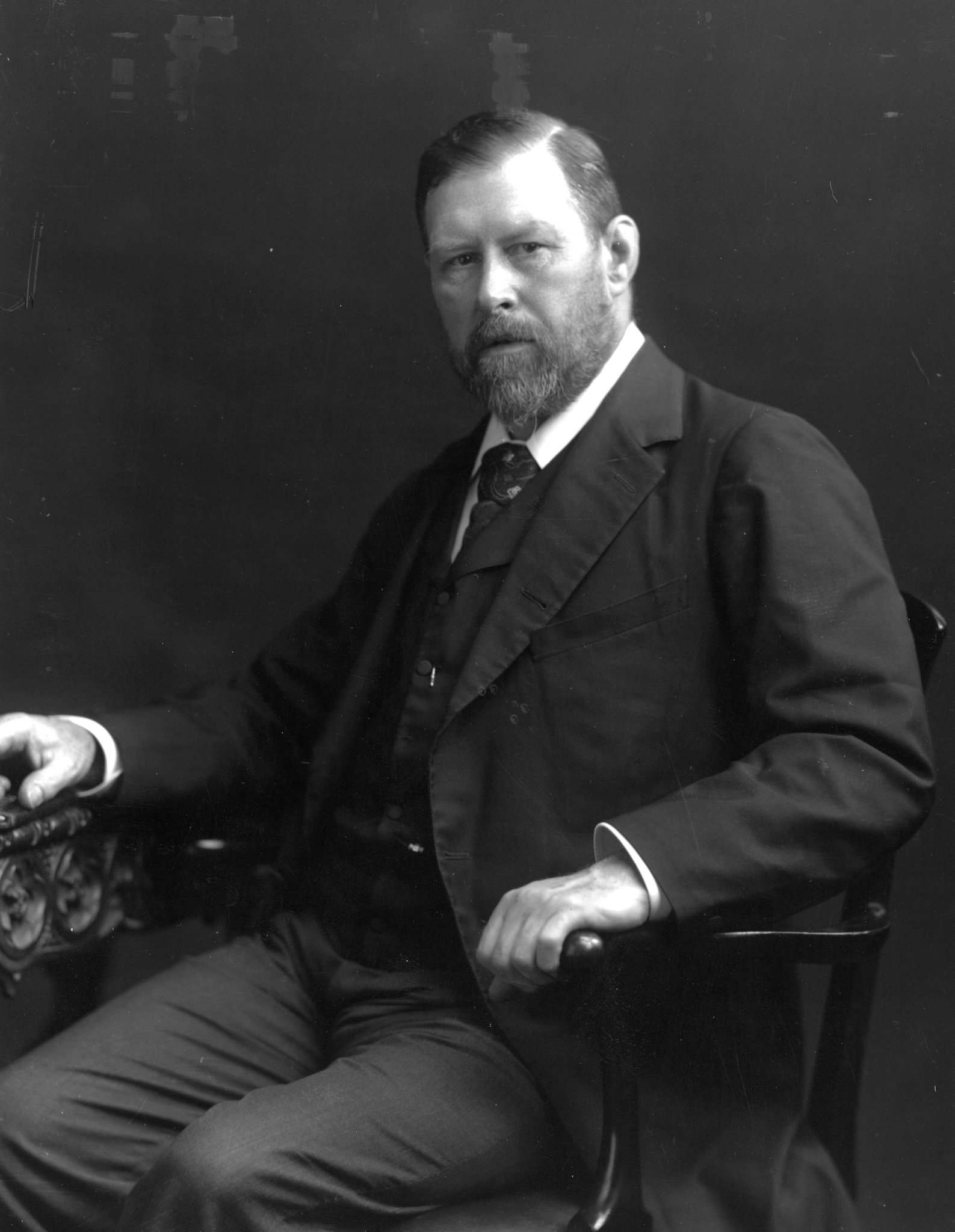 Born in Dublin, Ireland, on November 8, 1847, Bram Stoker published his first literary work, The Duties of Clerks of Petty Sessions in Ireland, a handbook in legal administration, in 1879. Turning to fiction later in life, Stoker published his masterpiece, Dracula, in 1897. Deemed a classic horror novel not long after its release, Dracula has continued to garner acclaim for more than a century, inspiring the creation of hundreds of film, theatrical and literary adaptations. In addition to Dracula, Stoker published more than a dozen novels before his death in 1912.
(Read more about Bram Stoker)
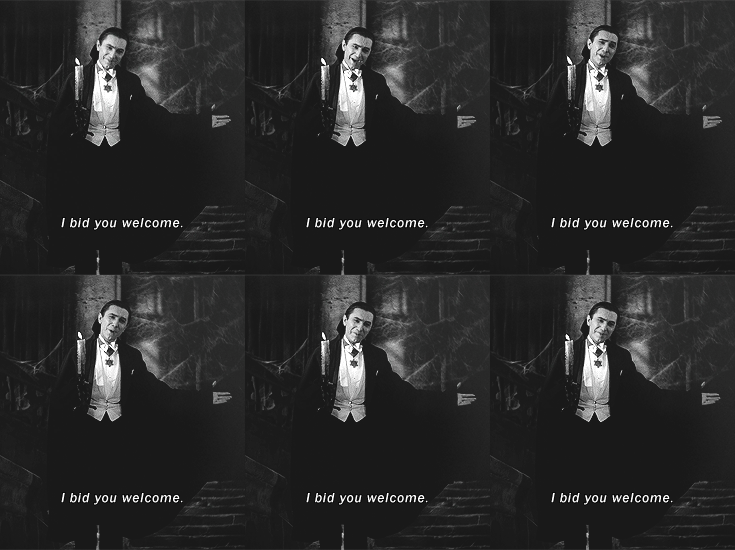 |
| "I bid you welcome." |
 |
| Nosferatu |
Despite the old language that the book was written in, I found myself reading a lot of it durng my free time, wanting to know what Dracula was going to do next and what the rest of the main characters were going to do about it. Like a Shakespearean play, after a while you get so used to the language that they use in the journal entries that you hardly notice how different it is.
 |
| Van Helsing "fighting" Dracula with sunlight |
 |
| Dracula dancing with Anna (Van Helsing) |
 |
| Renfield and Dracula (Dracula: Dead and Loving It) |
 |
| "If ever a look meant death - if looks could kill - we saw it at that moment." -Dracula, Chapter XVI |
ABOUT THE AUTHOR
(Read more about Bram Stoker)
A LITTLE EXCERPT
"I only slept a few hours when I went to bed, and feeling that I could not sleep any more, got up. I had hung my shaving-glass by the window, and was just beginning to shave. Suddenly I felt a hand on my shoulder, and heard the Count's voice saying to me, 'Good morning.' I started, for it amazed me that I had not seen him, since the reflection of the glass covered the whole room behind me. In starting I had cut myself slightly, but did not notice it at the moment. Having answered the Count's salutation, I turned to the glass again to see how I had been mistaken. This time there could be no error, for the man was close to me, and I could see him over my shoulder. But there was no reflection of him in the mirror! The whole room behind me was displayed; but there was no sign of a man in it, except myself. This was startling, and, coming on the top of so many strange things, was beginning to increase that vague feeling of uneasiness which I always have when the Count is near; but in that instant I saw that the cut had bled a little, and the blood was trickling over my chin. I laid down the razor, turning as I did so half-round to look for some sticking-plaster. When the Count saw my face, his eyes blazed with a sort of demonaic fury, and he suddenly made a grab at my throat. I drew away, and his had touched the string of beads which held the crucifix. It made an instant change in him, for the fury passed so quickly that I could hardly believe that it was ever there."
pages 40-41
(In a bad Transylvanian accent)
Vell, that's all for now.

~Sea-Solo
EXTRA! EXTRA!
Here are some clips of my favorite depictions of Dracula!:
Dracula Untold (2014)
Dracula: Dead and Loving It (1995)
Van Helsing (2004)
Hotel Transylvania (2012)
Supernatural S4E5 (2008)
Buffy the Vampire Slayer S5E1 (2000)
Twilight Sucks by Barely Political
Here are some clips of my favorite depictions of Dracula!:


